
How To Get A Municipal Compost Program Started In Your Community
Municipalities are often the main decision makers when it comes to what waste and recycling options are available to residents. In an effort to build more sustainable communities, more and more municipalities around the United States have implemented municipal compost programs.
Municipal compost programs can come in many different shapes and sizes. Whether your municipality is looking to achieve landfill independence, reach climate goals, or support local soil health, compost programs play a key role in creating stronger and healthier communities.
In this article, we will discuss:
Why your municipality should divert food scraps from landfills
What your municipality’s options are for starting a compost program
How to get in touch with WasteNot’s municipal management team
Why your municipality should divert waste from landfills
There are countless reasons why a municipality may be interested in starting a compost program.
Landfill space
In Cook County, 40% of all solid waste sent to landfills is organic material that could be composted at commercial compost facilities. The Illinois Environmental Protection Agency (IEPA) estimates that the entire state of Illinois has 19 years left of landfill space as of 2022.
With organics making up the largest portion of what is sent to landfills, composting – the process of turning food scraps and organic materials into a nutrient-rich soil amendment – has become a main solution for decreasing landfill use.
Methane emissions
You may hear a composting skeptic say, “Doesn’t my food waste break down in a landfill anyway?” This is a very common misconception!
When food scraps and organics are sent to landfills, they break down anaerobically (without oxygen) and release a significant amount of methane. Methane emissions caused by food waste in landfills creates 14% of the United State’s total methane emissions on an annual basis. Waste takes decades longer to breakdown in anaerobic environments.
Composting food waste at commercial composting facilities reduces associated methane emissions by 84%.
Healthier soils & local ecosystems
Not only are there fewer methane emissions when food waste is composted rather than landfilled, but local soils also benefit. Composting food waste and organics creates a nutrient-rich soil amendment known as finished compost.
Finished compost creates better soils for growing healthy food by repurposing the nutrients from our food waste, supports greater water retention to prevent flooding, and sequesters carbon in our soils - taking it out of the atmosphere (EPA source).
Municipal options for starting a commercial compost program
Commercial composting facilities are able to accept all food waste (including meat, bones, and solid dairy), 100% paper products, and BPI or CMA certified compostable products. For the purposes of this article, we will focus on the options that municipalities have for implementing compost programs that utilize commercial composting facilities.
You can learn more about the differences between composting on a commercial level and in your backyard in this article.
Please see below for the most common programs for diverting organic waste from landfills to commercial composting facilities:
Curbside collection
Many municipalities have opted for private-public partnerships to make curbside compost collection more accessible for residents. Curbside collection programs involve residents being able to utilize a small cart or bucket to collect their food scraps, 100% paper products, and BPI or CMA certified compostable products.
The municipality or private hauler then collects the waste similarly to how trash and recycling are handled.
These programs may even include options for participating residents to receive a portion of finished compost back on a seasonal basis.
WasteNot currently partners with the following municipalities for municipal curbside compost collection programs: The City of Lake Forest, the City of Evanston, the Village of Skokie, the Village of Morton Grove, the Village of Riverside, the Village of Evergreen Park, the Village of Pingree Grove, the Village of Glencoe, the Village of Oak Lawn, and the Village of Palos Park.

Example of a receptacle used for municipal curbside compost collection in Illinois
Community drop-off
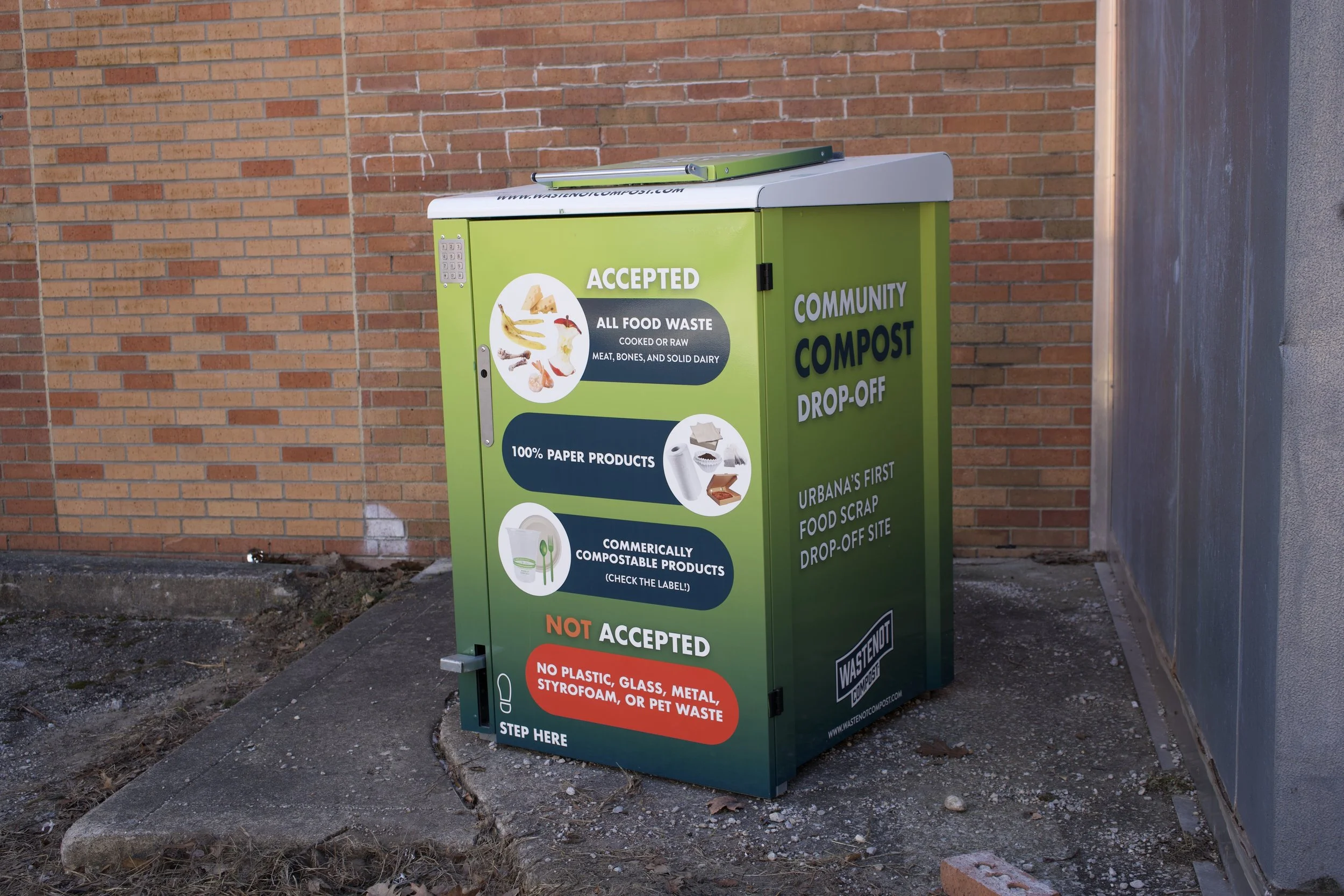
The community drop-off model has been implemented by municipalities to offer residents a centralized model for collection of food waste.
For these drop-off programs, the municipality dedicates one or more locations around the community as collection points with signage communicating what is accepted. Residents can then bring their food scraps to the drop-off points at their convenience.
WasteNot currently services community drop-off programs in the City of Evanston, the Village of Skokie, the Village of Wilmette, and the Village of Palatine.
Get in touch with WasteNot’s municipal team
Whether you are a passionate resident looking to be your community’s compost champion or a staff member looking into options for your municipality, WasteNot’s municipal composting team is here to help!
Get in touch with our team at partners@wastenotcompost.com.